



The RevOps Framework: People, Process, and Platform
Why buying more tools didn't fix it
Picture this. A growing company signs up for HubSpot. Marketing builds forms and email nurtures. Sales starts logging deals. Customer success tracks renewals in a spreadsheet "for now."
Six months later, the leadership meeting goes like this. Marketing says they sent 400 MQLs last month. Sales says they got maybe 80 worth calling. Nobody can say which campaign actually brought in revenue. Someone suggests adding another tool.
Sound familiar? Here's the thing: the problem was never the tool. HubSpot was doing exactly what it was set up to do. The real gap was that nobody had agreed on who owns what, how work moves from one team to the next, and how the system should support all of that.
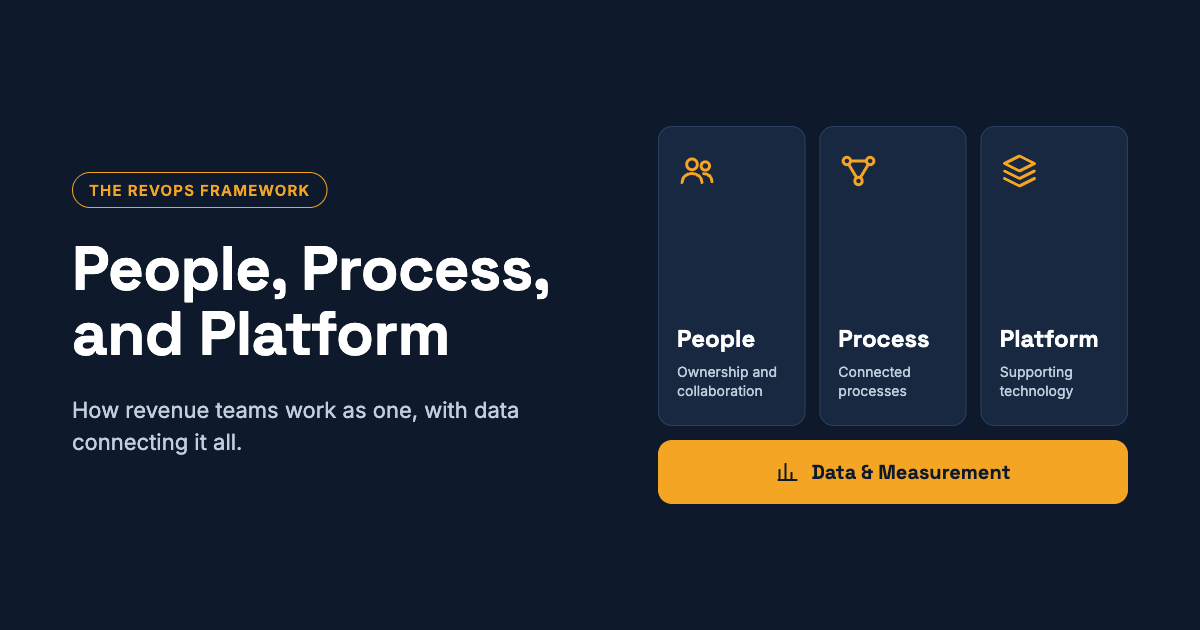
That's what the RevOps framework is for. In this post, we'll walk through its three parts, People, Process, and Platform, and the one thing that runs through all of them: data and measurement. By the end, you'll have a simple way to look at your own revenue engine and see where it's leaking.
The framework at a glance
RevOps is about getting marketing, sales, and customer success to work as one revenue team instead of three separate departments. A framework helps because it gives everyone the same map. When something breaks, you can point to where it broke instead of arguing about who broke it.
Think of it like building a house:
- People are the family living in it. They decide how the house is used and who is responsible for what.
- Process is the floor plan. It decides how you move from room to room without bumping into walls.
- Platform is the plumbing and wiring. You don't think about it when it works, but everything stops when it doesn't.
- Data and measurement is the foundation. Every part of the house sits on it.
The order matters too. People first, then process, then platform. Most companies do it backwards. They buy the platform, then try to squeeze their people and processes into whatever the tool does by default.
Pillar 1: People (ownership and collaboration)
The People pillar answers two questions: who owns each part of the revenue journey, and how do those owners work together at the hand-off points.
Ownership: every stage needs a name next to it
When everyone is responsible, no one is. Ask your team, "Who owns the lead between the moment a form is filled out and the moment a rep calls?" If you get three different answers, or silence, you've found a gap.
Good ownership means one person or team is accountable for each stage. For example:
|
Stage |
Typical owner |
What they're accountable for |
|
Attracting leads and nurturing MQLs |
Marketing |
Lead quality and sales-ready leads |
|
Turning SQLs into opportunities and deals |
Sales |
Pipeline, win rate, deal speed |
|
Onboarding and growing customers |
Customer success |
Retention, expansion, satisfaction |
|
The system and the data |
RevOps |
Clean data, working processes, reliable reports |
Notice that last row. Someone has to own the system itself, including the CRM, the data rules, and the reports. If that's "whoever has time," your HubSpot portal will slowly turn into a junk drawer.
Collaboration: the hand-offs are where revenue leaks
Teams rarely fail inside their own stage. They fail between stages. Marketing hands over a lead that sales thinks is cold. Sales closes a deal and tells customer success nothing about what was promised.
Collaboration doesn't mean more meetings. It means agreeing on a few things together:
- Shared definitions. What makes someone an MQL, and when are they sales-ready enough to become an SQL? Companies draw this line differently. What matters is that both teams agree on the criteria and on who makes the call. Write it down, and make sure marketing and sales both sign off.
- Service-level agreements (SLAs). For example, sales follows up on every SQL within 24 hours, and marketing delivers a set number of them each month.
- A shared goal. When every team is measured on revenue, not just their own number, they stop protecting their turf.
Quick check: if marketing celebrates hitting its lead target in the same month sales misses quota, your people aren't aligned yet. They're just busy.
Pillar 2: Process (connected processes)
Once you know who owns what, the next question is how work flows from one owner to the next. That's the Process pillar.
Most companies already have processes. Marketing has a way to run campaigns. Sales has a way to work deals. The problem is that these processes were built in isolation. Each one makes sense on its own, but they don't connect.
Think of it as one journey, not three departments
Your customer doesn't care about your org chart. To them, it's one experience. A connected process follows the customer from start to finish:
- Lead. Someone downloads a guide or fills out a form.
- MQL (marketing-qualified lead). They fit your ideal customer and show real interest. Marketing nurtures them until they're ready for a sales conversation.
- SQL (sales-qualified lead). They meet the sales-ready criteria both teams agreed on, and marketing passes them to sales. This is the big marketing-to-sales hand-off.
- Opportunity. Sales qualifies the SQL, confirms there's a real need, and opens a deal.
- Customer. The deal closes, and everything sales learned passes to onboarding.
- Retained and growing customer. Customer success keeps them happy and spots chances to expand.
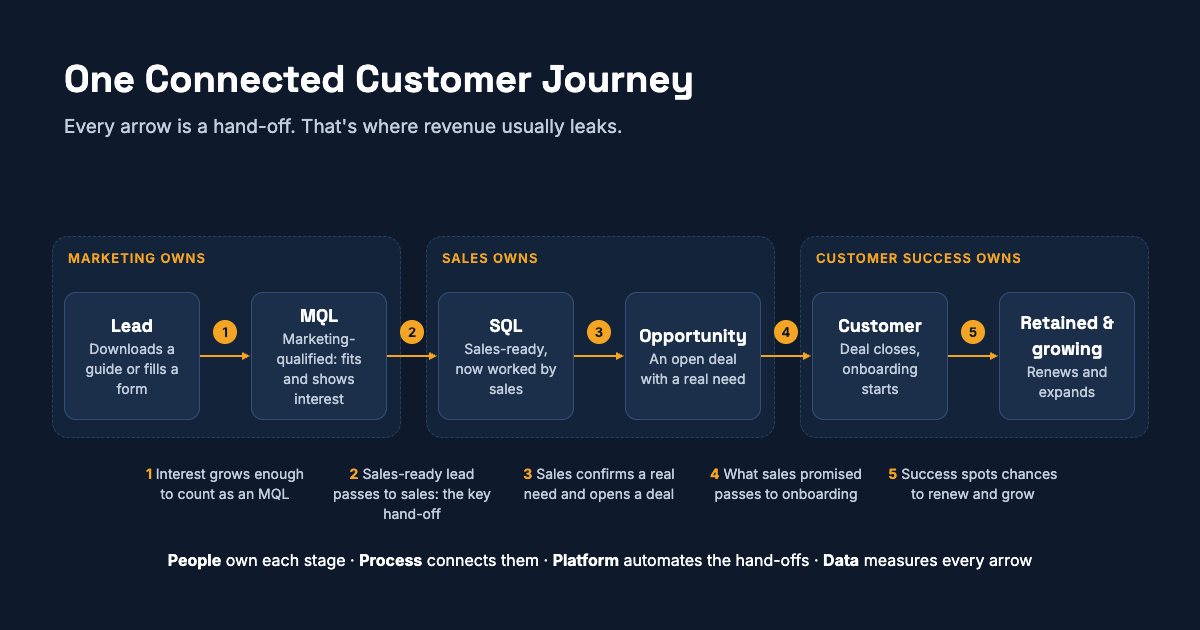
Each arrow between those steps is a hand-off. A connected process spells out exactly what happens at each one: what triggers it, what information moves with it, and who picks it up.
What a disconnected process looks like in real life
- A lead fills out a demo request on a Friday night. Nobody is notified. A rep finds it on Wednesday. The prospect has already booked a call with your competitor.
- A rep promises a custom integration to close the deal. The onboarding team finds out during the kickoff call, in front of the customer.
- A happy customer is ready to upgrade, but because sales and success use different notes, nobody knows.
None of these are tool problems. They're process gaps.
Start small
You don't need to map every process at once. Pick the hand-off that hurts most, usually the MQL-to-SQL hand-off from marketing to sales, and document it on one page: the trigger, the owner, the timeline, and the information that has to be included. Fix that one, then move to the next.
Pillar 3: Platform (supporting technology)
The Platform pillar is your tech stack: the CRM, marketing automation, help desk, and anything connected to them. For many teams, that's HubSpot at the center.
The key word here is supporting. Technology should support the people and processes you've already defined. It should not define them for you.
Why "tool first" goes wrong
When a company sets up the platform before agreeing on people and process, a few things usually happen:
- Default settings become your process. The standard deal stages get used even though they don't match how you actually sell.
- Everyone customizes on their own. Five people create five slightly different "Lead Source" properties. Now no report can be trusted.
- Automation speeds up the mess. A workflow built on a broken process just produces broken results faster.
That's why so many teams feel like HubSpot "isn't working." Usually the platform is fine. It was simply set up before anyone decided what it should do.
What a supporting platform looks like
When people and process come first, the platform becomes the place where your agreements live and run on their own:
- Your agreed lifecycle stages are built into the CRM, so every contact sits in the right stage.
- Your hand-offs are automated. When a lead becomes an SQL, the right rep is assigned and notified right away, not on Wednesday.
- Your SLAs are tracked. If a lead isn't followed up within 24 hours, someone knows.
- Your context travels with the record. Customer success can see what sales promised without asking.
A simple rule to remember: if you can't explain the process on a whiteboard, don't build it in the software yet.
The thread through everything: data and measurement
Data isn't a fourth pillar. It's what connects the three. Without it, you can't tell whether your people are aligned, whether your processes are working, or whether your platform is set up right. You're just guessing.
Here's how data shows up in each pillar:
|
Pillar |
The data question |
Example metrics |
|
People |
Is each owner hitting their part of the goal, and are teams working toward the same number? |
Lead-to-customer rate, quota attainment, retention by team |
|
Process |
Is work moving smoothly between stages, or getting stuck? |
Speed to first follow-up, stage conversion rates, time spent in each stage |
|
Platform |
Can we trust what the system tells us? |
Records missing key fields, duplicate contacts, tool adoption by the team |
Good data starts with agreement, not dashboards
A dashboard is only as good as the data behind it. And the data is only as good as the agreements behind it. If marketing and sales define MQL and SQL differently, no report in the world will make your numbers match.
So before building reports, make sure you have:
- One definition for each key term, like lead, MQL, SQL, opportunity, and customer.
- A short list of required fields that must be filled in at each stage.
- One source of truth. If the CRM says one thing and someone's spreadsheet says another, the CRM wins.
Measure the journey, not just the departments
The most useful metrics in RevOps sit between teams. Speed to follow-up tells you about the marketing-to-sales hand-off. Onboarding time tells you about the sales-to-success hand-off. These are the numbers that show where revenue is leaking, and they're often the ones nobody is tracking.
Start with a handful. Five metrics everyone understands and looks at every week are worth more than fifty that live in a dashboard nobody opens.
What happens when one pillar is missing
The three pillars only work together. Take one away and you'll feel it, even if you can't name it yet.
|
If you have... |
But you're missing... |
What it feels like |
|
Process and Platform |
People |
Beautiful workflows nobody follows. Every problem turns into "that's not my job." |
|
People and Platform |
Process |
Great teams, expensive tools, and a lot of improvising. Results depend on who's working that day. |
|
People and Process |
Platform |
Everyone knows the plan, but it lives in spreadsheets, sticky notes, and memory. It breaks the moment you grow. |
|
All three pillars |
Data |
Things seem fine until someone asks, "How do we know?" Then nobody can answer with confidence. |
If one of these rows made you wince, that's useful. It tells you where to start.
A 5-minute self-check for your team
Grab a coffee and answer these honestly. Every "no" or "not sure" points to your next step.
People
- Every stage of the customer journey has one clear owner.
- Someone is officially responsible for the CRM and its data.
- Marketing, sales, and customer success share at least one revenue goal.
Process
- We have written MQL and SQL definitions that both marketing and sales agreed on, including who decides a lead is sales-ready.
- Every hand-off has a trigger, an owner, and a time limit.
- New team members can learn our process from a document, not just by shadowing someone.
Platform
- Our CRM stages match how we actually sell, not the default setup.
- Key hand-offs happen automatically, with the right person notified.
- The team works in the CRM instead of side spreadsheets.
Data and measurement
- Everyone uses the same definitions for lead, MQL, SQL, opportunity, and customer.
- We track at least one metric for each hand-off between teams.
- When leadership asks a revenue question, we can answer it from one report.
Bringing it all together
RevOps isn't a tool you buy or a department you hire. It's a way of making sure your people, processes, and platform all pull in the same direction, with data keeping everyone honest.
If you remember just four things from this post:
- People first. Give every stage an owner and agree on how teams work together at the hand-offs.
- Connect your processes. Design one customer journey, not three separate department playbooks.
- Let the platform support, not lead. Build your agreements into the tool, not the other way around.
- Measure what matters, especially between teams. Clean, agreed-on data is what turns guesses into decisions.
And if your HubSpot portal feels like it's working against you, it probably isn't the software. It's usually one of these pillars asking for attention.
Not sure where to start?
If the self-check above left you with more "not sure" than "yes," you're not alone, and you don't have to sort it out by yourself. At Revefied, we help teams on HubSpot get their people, processes, and platform working together, so their data finally tells them the truth.
Get in touch with Revefied and tell us which pillar is giving you the most trouble. We'll help you figure out the first fix that will make the biggest difference.

Comments